Lead Qualification Questions: What to Ask, How to Ask It, and What You Are Actually Listening For
TL;DR: The difference between a lead qualification question and a good one is not the information it targets. It is whether the buyer experiences it as genuine curiosity or a structured interrogation. This guide covers the four things every qualifying conversation must surface, the specific questions that surface them naturally, what a useful answer actually sounds like versus a polite deflection, and how arriving at the call with GTM Intelligence already in hand changes the entire dynamic.
Why Most Question Lists Fail on a Real Call
The standard approach to lead qualification questions organizes them by BANT category: budget questions, authority questions, need questions, timeline questions. The logic is clean. The execution rarely is.
When a rep works through BANT as a checklist, the buyer feels it. The call becomes transactional before trust has been established. Budget questions in the first five minutes signal that you care about the sale more than the problem. Direct authority questions produce polite deflections. “Yes, I am the decision-maker” is one of the most common things buyers say when they are not.
The deeper structural problem is that conversation does not unfold by category. On a real discovery call you are listening for threads, following them, and assembling a picture. You do not finish the need questions and then shift to the timeline questions. The information comes in pieces, woven into whatever the buyer is actually talking about. A rigid list produces rigid conversations, and rigid conversations close fewer deals.
What works instead: know the four things you need to surface, have two or three natural questions for each, and let the conversation determine the order.
The Four Things Every Qualifying Conversation Must Surface
Before a lead earns a place in your pipeline, you need clear answers to four questions. Not twenty. Four.
One: Is the problem real and significant enough to act on?
A lead can describe a problem without being in pain. Pain means the problem is costing something measurable right now, or will cost something measurable soon. A problem that is acknowledged but tolerated is not a current sales opportunity. It is a future one, and treating it as present-tense pipeline is how forecasts miss every quarter.
Two: Is there a genuine path to a decision?
The person on the call may have a real problem and no authority to act on it. Or they may have authority but no budget process. Or they may have both but a competing priority that will absorb every available resource this quarter. A path to a decision means there is a realistic route from this conversation to a signed agreement, and you can at least sketch what that looks like.
Three: Is something driving this to happen now, not someday?
Urgency is not the same as interest. Interest is polite and cheap. Urgency means something has changed, or is about to change, that makes the cost of doing nothing higher than the cost of acting. Without urgency, even a well-qualified lead goes cold. As I have seen in practice across many B2B sales cycles, “someday” deals are not pipeline. They are goodwill.
Four: Are you talking to the right person?
Not necessarily the economic buyer. The right person is someone involved enough in the problem and the decision to either move things forward directly or connect you to whoever can. A contact with no influence and no access to influence is a dead end, however warm the conversation feels.
The Questions, the Natural Version, and What You Are Actually Listening For
Surfacing whether the problem is real
The version that does not work: “Do you have a need for this?” Nobody asks it that bluntly, but plenty of reps ask versions that produce the same non-answer.
“Walk me through what this looks like for you right now.” Open, unhurried, and signals to the buyer that you are genuinely interested in their situation rather than your pitch. A buyer with a real problem will talk at length and with specificity. A buyer who is still in early-stage curiosity will give you a short, vague response. The length and detail of what comes back tells you more than the content itself.
“What made you look into this now, rather than six months ago?” One of the most revealing questions in any qualifying conversation. It forces the buyer to name the trigger event — or to acknowledge that there is not really one. An answer like “we have been thinking about it for a while” is a signal to probe further. An answer like “we just lost a deal because of exactly this issue” is both an urgency signal and a confirmation that the problem is real. One question, two criteria surfaced.
“What have you already tried to solve this?” A buyer who has tried nothing is probably still in the research phase. A buyer who has tried two or three things and is still looking has genuine pain. The answer also tells you what has already failed, which directly shapes how you position your own solution and what objections to anticipate.
What you are listening for: specificity, frustration, and a cost they can name. Vague discomfort is not enough to close a deal. You want a buyer who can describe what the problem is costing them in time, money, pipeline, or missed opportunity — and ideally give you a number.
Surfacing the path to a decision
The version that does not work: “Are you the decision-maker?” Almost always gets a yes that is wrong.
“Who else would typically be involved in evaluating something like this?” Not “are you the decision-maker.” This version assumes involvement from others — because there almost always is — and invites the buyer to map the buying committee rather than defend their personal authority. The answer tells you who you are not yet talking to, which is the actual intelligence you need.
“How does your company typically evaluate and approve a tool like this?” Surfaces the decision process without putting the buyer on the spot about where they sit in the hierarchy. You learn whether there is a formal procurement process, whether IT or legal must be involved, whether the budget needs to be created or is already allocated. That information shapes every subsequent step in the sales process.
“If this turned out to be exactly what you need, what would have to happen internally to move forward?” The question most reps hesitate to ask because it sounds presumptuous. It is not. It is asking the buyer to describe the path from interest to decision in their own terms. The answer is your deal roadmap. If the buyer hesitates or gives a vague answer, that tells you the decision path is unclear to them too — which is itself important information to surface early, not in week eight.
What you are listening for: clarity and specificity, not just confidence. A buyer who describes the decision process with specific names, steps, and typical timescales is telling you the deal is real. A buyer who says “we will figure it out when the time comes” is telling you the decision is not yet imminent.
Surfacing urgency
The version that does not work: “What is your timeline?” Generates a lot of “end of quarter” answers that mean nothing and cannot be held to.
“What happens if this problem does not get resolved in the next 90 days?” The cost of inaction is more revealing than any stated timeline. If the buyer struggles to answer, the urgency is not there yet. If they answer quickly and with specifics — “we miss the product launch, the onboarding backlog doubles, the new VP is going to want answers” — you have a real forcing function to work with.
“Is there anything driving a decision by a particular date?” More honest than “what is your timeline?” because it acknowledges that many buyers do not have a hard deadline. It gives the buyer permission to say “not really,” which is useful information. It also invites them to surface contract renewals, board reviews, team expansions, or other real calendar events that create natural urgency.
“Where does this sit on your priority list right now … honestly?” The word “honestly” carries significant weight in this context. It signals that you can handle the real answer, and it usually produces one. A buyer who says “it is probably third on the list right now but will be number one by next quarter” is giving you a precise, actionable read on timing. A buyer who says “it is number one” but cannot articulate what happens if it slips is probably overstating its urgency.
What you are listening for: external events, not internal intentions. Intentions to act are cheap. An expiring contract, a new hire being onboarded, a product launch that depends on this problem being solved, a board presentation in five weeks — those are the urgency signals that actually move deals from pipeline to closed.
Surfacing whether you are talking to the right person
The version that does not work: “Can you make this decision?” Produces almost no useful information and occasionally offends.
“How did you get involved in looking at this?” Surfaces the buyer’s real role without asking about authority directly. Someone who owns the problem will answer differently from someone who was asked to do research. The former is a potential champion. The latter is a door into the organization — still valuable, but requiring a different next step.
“Is there anyone else who should be in the next conversation?” Simple, direct, and non-threatening. The answer tells you whether you are talking to someone who can advance the deal or someone who will need to brief their manager before anything moves. If the answer is “actually, yes, my VP should probably be involved,” that is progress, not a complication.
“When you picture this being implemented, who would be most involved in making that happen?” Shifts the frame from evaluation to execution, which often surfaces stakeholders the buyer did not mention when asked about authority directly. Implementation conversations involve IT, procurement, finance, and the team who will use the product. Any of those people can stall a deal that looked on track, and knowing they exist early is far better than discovering them at the proposal stage.
What you are listening for: ownership and access. You are not looking for a perfect decision-maker in the first conversation. You are looking for someone who genuinely owns the problem and can either act on it themselves or get you in front of the person who can.
The Questions That Sound Casual but Are the Most Revealing
Three questions earn their place in every qualifying conversation not because they target a specific framework criterion, but because the quality of the answer tells you almost everything you need to know about where a deal actually stands.
“What does success look like for you, specifically?”
A buyer who answers this in concrete, measurable terms is serious. A buyer who gives you a vague aspiration is still forming their thinking. The specificity of their vision for success is one of the best predictors of the urgency behind the purchase.
“What would make you decide not to move forward with anything?”
Surfaces objections before they become blockers. A buyer who says “we would not move forward if the integration requires more than two weeks of IT time” is telling you exactly where to focus the rest of the sales process. A buyer who cannot think of anything is either very early in their thinking or very close to a decision.
“Have you looked at other solutions? What did you think?”
Where the buyer is in their evaluation, what they have already dismissed and why, and what they found compelling in alternatives are all meaningful signals. More importantly, a buyer who is actively comparing options is in a different and more serious buying mode than someone who is casually exploring the category.

What to Do With the Answers
The point of a qualifying conversation is not to complete a checklist. It is to build a picture clear enough to make a confident binary decision: does this lead belong in active pipeline, in nurture, or out of the funnel entirely.
After the call, three questions should have clear answers. Is the problem real and specific enough that a deal is possible? Is there a realistic path from this conversation to a signed agreement? Is there something driving the timing that makes soon genuinely plausible?
If all three are yes, the lead is qualified. Move it forward with a specific next step, agreed on the call, with a date attached.
If one is unclear, define exactly what would make it clear and set a focused follow-up with that as the sole objective.
If two or more are genuinely no after a full conversation, the lead is not ready. Place it in a nurture sequence with a specific re-engagement trigger — contract renewal date, end of fiscal year, a hire that would change the situation — and redirect your attention to leads that are ready now. The discipline to do this consistently is what separates teams running a less-is-more sales strategy from teams running a pipeline full of noise.
A lead that felt like a good conversation but produced no clear answers to those three questions is not a pipeline opportunity. It is a polite waste of time dressed up as progress.
What Changes When You Already Know the Context Before the Call
Every question above assumes you are walking into the call cold, assembling the picture from scratch. That is the default situation for most sales reps, and it is the most time-consuming version of the qualification process.
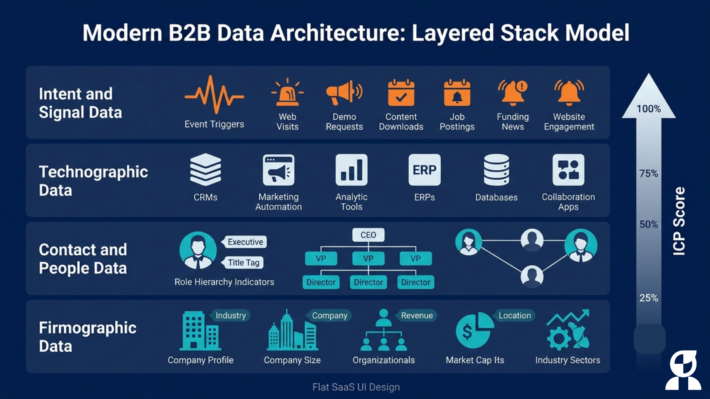
When you arrive at a qualifying conversation already knowing the lead’s company context, the key executive’s background, recent relevant company news, the likely business pains given their profile, and how closely they match your Ideal Customer Profile — the conversation changes materially. You spend less time gathering basic firmographic context and more time confirming the specific things only the buyer can tell you: whether the urgency is real, how the decision process actually works, and whether the problem is significant enough to act on now.
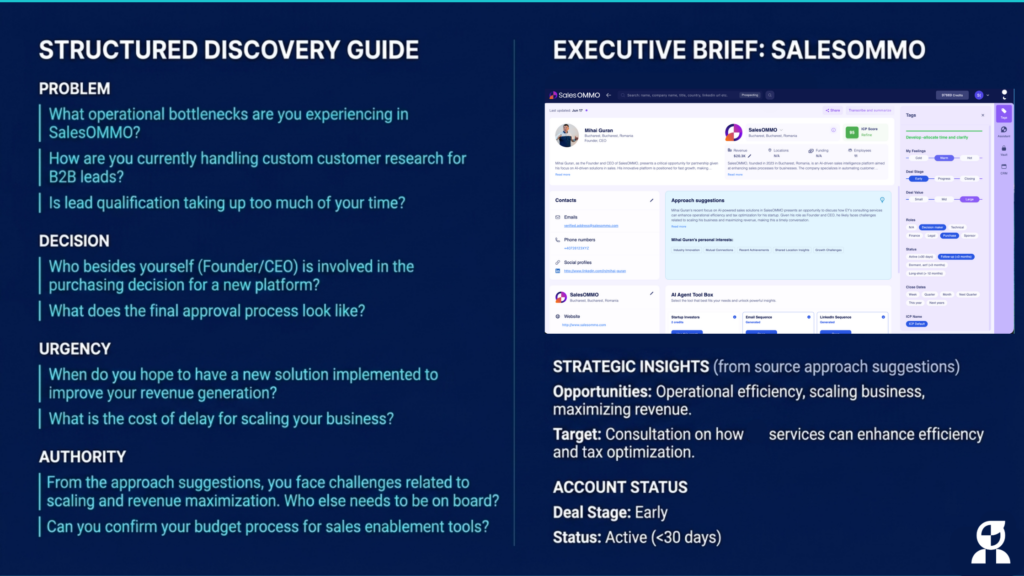
This is the shift GTM Intelligence makes at the infrastructure level. SalesOMMO’s Executive Brief gives you the company context, key executive insights, industry challenges, and an ICP Score before you make first contact. The 20 to 40 minutes of manual research per lead (the time most founders performing their own sales and many busy sales executives simply do not have) is done before the lead arrives on your dashboard.
The qualifying conversation becomes sharper and shorter as a result. You are not building a hypothesis from scratch. You are confirming one. The questions above still matter. They just land differently when the buyer can tell you are already prepared, already know their context, and are asking because you want to understand their specific situation — not because you are filling in the blanks you should have filled in before picking up the phone.
This is the human-in-the-loop architecture that separates Agentic-AI qualification done well from automation done badly.
The AI handles the research, the ICP scoring, the Executive Brief, and the draft personalized messages for the outreach.
The human handles the judgment, the conversation, the relationship, and the close. Precision over volume.
Fewer calls, better prepared, higher win rates.
SalesOMMO is the GTM Intelligence platform for entrepreneurs and B2B sales teams. No more spray-and-pray. No more AI-slop. Upgrade human judgment with data and insights. Amplify humans, not inboxes.
Get up to 150 new ICP-scored MQLs per month, with optional Agentic-AI qualification to narrow those into the SQLs that genuinely deserve your time. Full feature detail (ICP Score, Executive Brief, Agentic-AI qualification) at salesommo.com/features.
Free to start. From €99/month at salesommo.com.