Types of Sales Intelligence Data B2B Teams Use and How to Layer Them
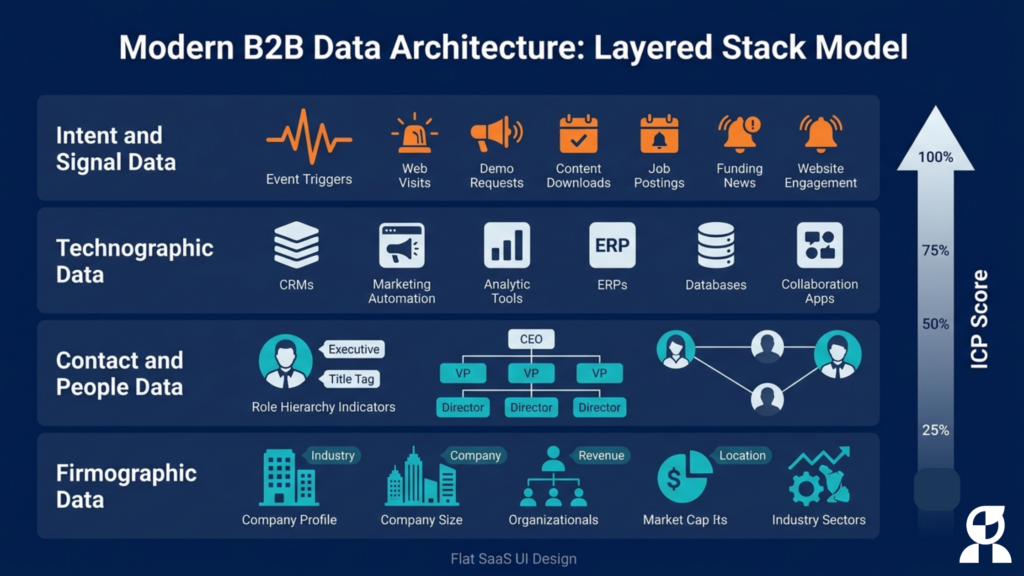
TL;DR: Sales intelligence runs on four data types: firmographic, contact and people, technographic, and intent or signal data. Each one answers a different question about the account. No single type is sufficient on its own. Firmographic data tells you who fits. Contact data tells you who and where to call. Technographic data tells you how a company operates and whether your solution belongs in its stack. Intent data tells you when the buying window is open. The competitive advantage comes from layering all four into one picture, kept current, before the first conversation happens.
One Account, Three Questions, Four Data Types
A seller looks at an account and needs to answer three questions before investing serious time in it. Is this company a genuine fit for what I sell? Who inside it should I actually be talking to? Is anything happening right now that makes this the right moment to reach out?
Each question is answered by a different category of data. A team that treats all of it as one undifferentiated pile — or that has access to one type and is blind on the others — consistently acts on the wrong information at the wrong moment. The work that looks like a targeting problem is usually a data-layer problem.
This matters more now than it did five years ago. Gartner’s research finds that B2B buying decisions now run through groups of six to ten stakeholders, each with a different role in the decision, a different frame of reference, and a different threshold for engagement. Knowing the company looks right on paper is no longer sufficient when ten people shape what actually gets bought. You also need to know which of those people to reach, what each one cares about, and when the group is actively evaluating. Those are three different data types doing three different jobs.
What follows is a clear account of each one: what it covers, where it is most useful, and where it fails when used alone.
Why No Single Data Type Is Enough
The reason to separate the types is that they answer fundamentally different questions, and a team with only one is blind on the others in ways that are not always visible until the number misses.
Firmographic data tells you a company looks like a fit but says nothing about whether anyone inside it is ready to buy or who holds the relevant decision authority. Intent data tells you something significant is happening at an account but not whether it matches your Ideal Customer Profile or who to call when you reach them. Contact data gives you a name and a verified email address and no reason to believe either the timing or the fit is right. Technographic data tells you what systems a company runs but not whether a buying window is open.
The value of sales intelligence comes from the layering. Fit narrows the field to accounts worth pursuing. People data routes you to the right person inside each one. Technographic context shapes how you position the solution. And signal data sets the priority and the timing, telling you which of your fit accounts to move on this week rather than next quarter.
A platform that delivers all four layers, kept current, is what turns a list of company names into a prioritized set of accounts worth working right now. That is the distinction between a data purchase and a genuine intelligence practice.
Firmographic Data: The Foundation Layer
Firmographic data describes the company itself — its size by headcount and revenue, its industry classification, its geography, its corporate structure, and its ownership. These are the stable facts that determine whether a business belongs in your market at all.
What it covers and where it helps most. The clearest use for firmographic data is defining and enforcing the Ideal Customer Profile with precision. With accurate firmographic records, a team can specify the exact company type it wins with — industry vertical, employee band, revenue range, geography — count how many businesses match that description in a target market, and direct effort at that set rather than at whatever comes through the door.
Firmographic data also resolves a practical ambiguity that matters more than it sounds: separating a local subsidiary from its global parent, for example, changes the real size of a deal and the complexity of the decision process entirely. Without accurate firmographic context, a seller can spend weeks on an account that has no independent budget authority.
Where it falls short alone. Firmographic data is necessary but not sufficient. A company can match your profile precisely — right industry, right size, right geography — and have no intention of purchasing anything this quarter or the next. Used without any other layer, firmographic data produces a large list of plausible accounts with no way to rank them by readiness. The fit is real. The timing is entirely missing. Sending a seller’s hours to companies that fit on paper but are years from a decision is the most common way a well-structured prospecting list produces disappointing results.
Contact and People Data: The Routing Layer
A company does not make a purchase. The people inside it do. Which makes the people layer as consequential as the company layer it sits on top of — and in complex B2B deals, arguably more so.
Finding the right person instead of the right company. Contact data identifies individuals inside a target account, their specific roles and seniority levels, and verified channels for reaching them directly. The practical job it does is precision: reaching the person whose problem your solution addresses rather than a general company inbox or a name three organizational levels removed from any real decision authority. A seller with accurate, current contact data opens the first conversation with the right person. A seller without it spends the first week being routed toward them, which is a week the buying window might close.
Mapping the full buying group, not just the obvious contact. Gartner’s six-to-ten-stakeholder finding is the most important structural change in B2B purchasing of the last decade. Each member of the buying group brings a different concern: the budget holder evaluates return on investment, the end-user evaluates ease of adoption, the IT function evaluates integration complexity, the procurement team evaluates contract terms. People data lets a seller map that group before the first conversation — understanding who carries real influence, who will raise the objections, and who needs to be brought in before the deal can advance — rather than discovering the full committee halfway through a deal that looked like it was almost closed.
The decay problem that makes this layer uniquely perishable. Contact data has the shortest reliable shelf life of any sales intelligence type. People change roles, get promoted, move to different companies, and leave the workforce at a rate that makes B2B contact records decay at roughly 30% per year. A contact list accurate in January is meaningfully unreliable by summer. This is the category where continuous refresh matters most, and where a one-time database purchase loses its value fastest. A team working from stale contact records wastes its best conversations on people who have already moved on and creates a poor first impression with whoever inherited the role.
Technographic Data: The Context and Fit Layer
Technographic data describes what a company actually runs — its software stack, its infrastructure platforms, the tools that operate its core functions. It does double duty as both a fit signal and a timing signal, which makes it more versatile than it is often given credit for.
What it reveals about a company. Technographic data tells you how a business operates in practice, rather than how it describes itself in a category label. A company’s CRM, its marketing automation platform, its ERP, the infrastructure it uses for data and security — these details reveal the organizational maturity, the technical sophistication, and the integration landscape your solution would need to fit into. In many cases, that is more honest and more predictive than the industry classification in a firmographic database.
Why it signals both fit and timing simultaneously. A company running a particular platform may be an ideal fit for a solution that integrates with it natively, or a strong prospect for one that replaces a legacy system it is clearly outgrowing. Either way, the technology stack tells a seller something the firmographic data alone cannot: whether the solution has a natural place in how this business already works.
A change in the stack is also a timing signal. A company adopting a new CRM, migrating infrastructure, or expanding its technology footprint is in a period of active evaluation where complementary solutions are being considered. Reaching them during that transition window is materially different from reaching them 18 months later when the stack is settled and switching costs are high.
How it shapes the conversation before it starts. Knowing a company’s technology lets a seller position the solution as something that fits how the business already operates — not a disruption, but a complement or a logical next step. It also prevents the wasted pitch: proposing an integration with a system the company does not use, or recommending a tool that duplicates something already in the stack, signals immediately to the buyer that the seller did not do the basic research. In a buying environment where the shortlist is largely formed before first contact, that signal is expensive.
Intent and Signal Data: The Timing Layer
The fourth type is the layer that turns a fit account into a priority account — and it is what separates a timely, relevant conversation from a cold one that arrives before or after the buying window.
Event signals: observable changes that open a window. Event signals are discrete, verifiable changes in a company’s situation. A funding round creates budget that was not there last month. A senior leadership hire — a new CFO, a new Head of Operations, a new CTO — typically brings a 90-day review of existing vendors and a mandate to evaluate alternatives. An office expansion, a merger, or a market entry into a new geography all suggest that priorities and budgets are shifting in ways that create natural openings.
A seller who reaches an account in the weeks following a Series B announcement or a new VP hire is arriving at a moment when the company is already oriented toward evaluating new solutions. A seller who reaches the same account six months later is arriving after the decisions from that window have already been made.
Behavioral signals: earlier and quieter, but often more valuable. Behavioral signals come from what a company is actively researching — the topics its people are reading, the solution categories they are evaluating, the content patterns that suggest a purchase is being considered but not yet announced. These signals are subtler than event data but frequently earlier, catching a buying window as it opens rather than after it is already visible to multiple competitors.
In terms of competitive advantage, behavioral signals are where the real opportunity lives. An event like a funding round is public information that every vendor in the category can act on. A behavioral signal identifying that a specific company is actively researching your solution category before anyone else sees it is a window that only the teams with access to that signal layer can use.
Why timing on intent data is not optional. A signal is only worth having if you act on it while it is live. Intent data is the most time-sensitive type in the entire stack. A company researching a solution category actively today will have a shortlist within weeks. A seller who surfaces that signal and reaches the account the same day is competing for the deal from the beginning. A seller who finds the same signal four weeks later is reaching out after the shortlist is already written and the leading vendor has already established a relationship.
This is one of the structural reasons proactive, seller-initiated opportunities close at 33 to 41% while reactive, buyer-initiated opportunities close at 18 to 25%. The seller who acts on the signal before the buyer surfaces publicly is entering a completely different competitive situation.

How to Layer These Data Types in Practice
Having access to all four types is the starting point. Using them in the right sequence is what produces a result.
Start with firmographic data when prospecting in order to define the universe of accounts that belong in your market at all. There is no point acting on a buying signal from a company that was never a fit for what you sell. Firmographic filtering is the first and fastest way to direct the team’s attention away from accounts that will never close.
Layer technographic data to refine that field further. Among all the companies that match your firmographic profile, the ones whose technology stack is compatible with your solution, or that are mid-migration away from something your solution replaces, are the highest-fit subset. Technographic context also shapes the pitch before the first conversation happens.
Add contact and people data to identify who to reach inside each account before making any outreach decision. Knowing the company is right and knowing who to call are different problems, and the second one needs to be solved before any outreach is worth sending.
Then let intent and signal data set the priority order across all the accounts that pass the first three layers. Among your fit, reachable accounts, the ones showing active buying signals get the team’s attention this week. The ones that fit but show no current signal go into a monitored list with a defined re-engagement trigger.
Across all four layers, keep the data current. Every type decays, and contact data decays fastest. And qualify against the combined picture before investing real sales time — which is the practice that separates a team running a less-is-more sales strategy from one managing a pipeline full of noise.
SalesOMMO’s GTM Intelligence platform delivers all four data layers as a single, integrated account picture rather than four separate feeds a seller has to pull together manually.
The platform enriches each account with firmographic and contact data, applies ICP scoring against the profile you define, surfaces buying signals automatically, and generates an Executive Brief that puts the full layered context in front of you before the first meeting. Agentic-AI qualification advances the highest-fit accounts from MQL to SQL based on the signal picture, not on guesswork.
The work of gathering, combining, and interpreting four types of data across a pipeline of 30 to 50 accounts gets handled by the system. The judgment about who to pursue and how to win them stays with the human selling — which is the human-in-the-loop architecture that makes the whole system work as intelligence rather than as automated noise.
Frequently Asked Questions
What are the main types of sales intelligence data?
There are four. Firmographic data describes the company itself — size, revenue, industry, geography, and structure. Contact and people data identifies the individuals inside the account, their roles, seniority, and verified contact details. Technographic data reveals the tools and platforms a company uses to operate. Intent and signal data captures timing, through observable event signals such as funding rounds or leadership hires, and behavioral signals such as active research in a solution category. Each type answers a different question, and a complete, actionable picture requires all four working together.
Which type of sales intelligence data is most important?
No single type is most important in isolation, because they answer different questions and each fails when used alone. Firmographic data tells you who fits but not when to move. Intent data tells you when to move but not whether the company is right or who to call. Contact data gives you a person to reach but no context for why now. The competitive advantage comes from layering all four: fit narrows the field, technographic data refines it, people data routes you to the right person, and intent data sets the timing and priority.
How often does sales intelligence data need to be updated?
Continuously, because every data type decays and contact data decays fastest. People change roles and companies at a rate that makes B2B contact records roughly 30% inaccurate within a year of collection. Firmographic data shifts more slowly but changes with acquisitions, restructures, and growth. Intent signals are inherently time-sensitive and lose their value within weeks of the buying window they indicate. Intelligence built on stale data misleads rather than helps, which is why a platform that refreshes continuously is fundamentally different from a one-time database export.
What is the difference between firmographic and technographic data?
Firmographic data describes what a company is — its size, industry, geography, and structure. Technographic data describes what a company uses — the software platforms, infrastructure tools, and operational systems it runs. Firmographic data tells you whether a company fits your profile in general terms. Technographic data tells you whether your solution has a natural place in how the business already operates, and often doubles as a timing signal when a company is actively changing its stack.
What is intent data in B2B sales intelligence?
Intent data is the information that indicates a company may be in an active buying window. It comes in two forms: event signals, which are observable changes such as funding rounds, leadership hires, or market expansions that suggest budgets and priorities are shifting; and behavioral signals, which come from what a company’s people are actively researching online. Both forms point to a window of opportunity. Intent data is the most time-sensitive type in the stack — its value decays quickly as a company moves from research to shortlist to decision, which is why acting on it fast matters as much as having access to it.
SalesOMMO is the GTM Intelligence platform for entrepreneurs and B2B sales teams. No more spray-and-pray. No more AI-slop. Upgrade human judgment with data and insights. Amplify humans, not inboxes.
Get up to 150 new ICP-scored MQLs per month, with optional Agentic-AI qualification to narrow those into the SQLs that genuinely deserve your time. Full feature detail (ICP Score, Executive Brief, Agentic-AI qualification) at salesommo.com/features.
Free to start. From €99/month at salesommo.com.