How Sales Intelligence Helps B2B Sales Teams Hit Their Targets
TL;DR: Missing quota is now the statistical norm in B2B sales, with 76% of sellers falling short in the first half of 2025. The root cause is not insufficient effort. Analysis of more than 150 sales teams identifies misdirected effort (i.e. chasing the wrong accounts) as the single biggest reason teams miss. Sales intelligence fixes this by pointing the same selling hours at accounts that fit, but also show a form of buying intent. This article covers what moves the number, why small teams feel the gap most acutely, and how SalesOMMO’s GTM Intelligence closes it without adding headcount or volume.
Three Weeks Left and the Number Is Not Landing
The pipeline looks full in the CRM. But half of it has gone quiet, a third was never qualified properly, and the deals still active are stuck behind buying committees that keep expanding. If this pattern is familiar, the data says you have a lot of company.
The Ebsta x Pavilion 2025 GTM Benchmarks found that 76% of sellers missed quota in the first half of 2025. Average quota attainment has settled in the low forties. Win rates have fallen to around 19%, down from 29% the year before. Selling got structurally harder: longer cycles, more cautious buyers, and buying groups that now routinely run to six or more stakeholders on decisions that used to involve two.
The instinct in this environment is to push for more activity: more calls, more emails, more pipeline entries. The evidence points in a different direction. The gap is not in the effort. It is in where the effort is going.
Missing Target Is a Targeting Problem Before It Is an Effort Problem
When Revenue Velocity Lab analyzed quota attainment across more than 150 sales teams, drawing on research from Gong and Revenue.io, the single biggest reason teams missed was chasing the wrong deals.
Top performers had value-focused conversations with fit buyers 52% more often than the reps who fell short. The reps who missed were not working less. They were working the wrong accounts just as hard.
That reframing matters because it changes what the fix is. A sales person working full days on poor-fit prospects stays busy and still misses, because effort on the wrong account produces motion without progress. The same analysis found that introducing consistent deal scoring (i.e. enabling people to concentrate attention on the opportunities with the highest expected value) could lift quota attainment by 15 to 20% within 90 days, with no additional headcount. Every percentage point of that gain came from redirecting existing effort, not adding new activity.
This is the structural problem that sales intelligence is designed to solve. By enriching every account with firmographic fit data and live buying signals, it tells a seller which of the 30 open opportunities in the pipeline actually deserves this week’s hours, and which are quietly consuming capacity that should be elsewhere. The team does not get larger. The hours get better.
The Three Places Sales Intelligence Moves the Number
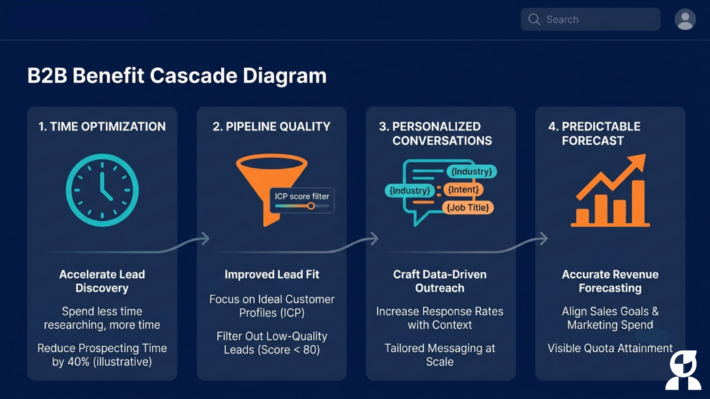
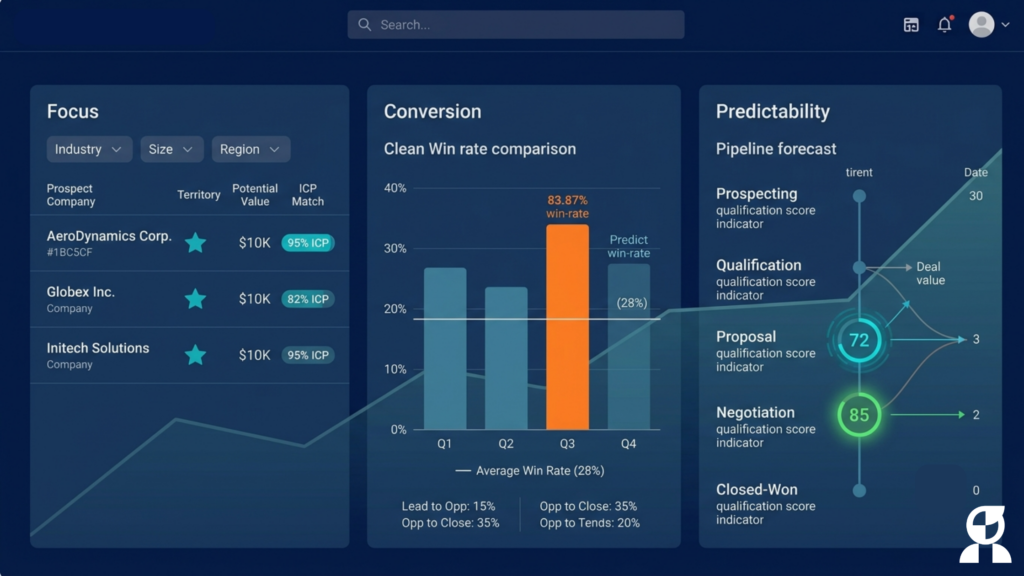
Quota is an output. It responds to three inputs that sales intelligence acts on directly, and each one is measurable independently.
Focus: Directing Limited Hours at Winnable Accounts
A B2B sales rep spends between 28% and 30% of the working day actually selling. The rest disappears into research, data entry, tool-switching, and internal coordination. That scarce selling time is the most valuable resource a team has, and the majority of it currently lands on accounts that will not buy.
Sales intelligence concentrates it. When you can see which companies match your Ideal Customer Profile and which are showing a signal that a buying window has opened — a funding round, a leadership change, a relevant hiring spike — the prospecting decision stops being a guess and becomes a data-informed choice.
This is what makes proactive selling viable for a small team. Research presented at the 2025 Emblaze Revenue Summit found that seller-initiated opportunities close at 33 to 41%, against 18 to 25% for reactive, buyer-led ones. Going out to find the right accounts wins at nearly double the rate of waiting for inbound — but only if you can identify the right accounts fast enough for the motion to pay. Without a data layer surfacing fit and intent, proactive selling is just cold calling with extra steps.
Conversion: Winning More of the Deals Already in the Pipeline
Focus fills the pipeline with better accounts. Preparation wins more of them once they are in.
ZoomInfo’s 2025 Customer Impact Report found that teams using sales intelligence closed 46% of deals, against 32% for teams selling without it. The 14-point win rate difference compounds significantly across a full year of pipeline. Average deal size grew by 40% among intelligence-driven teams, with enterprise account values roughly doubling in cases where the practice was most deeply embedded.
The mechanism behind the number is not complicated. When you understand a company’s situation before you make first contact (i.e. their recent news, their leadership’s priorities, the business pain your solution addresses) your outreach stops sounding like every other vendor’s sequence. You reference the specific change in their business that makes your solution relevant right now. You speak to the person whose actual problem you solve. The conversation starts further along because the buyer can tell you did the homework most sellers skip.
Higher win rate on the same pipeline is the most direct route to target attainment that exists, because it requires no additional volume at all. It simply requires more relevant conversations at the moment the buyer is ready to have them.
Predictability: Turning the Forecast Into Something You Can Manage Against
A target you cannot forecast reliably is a target you hit by luck. Roughly 57% of SaaS sales reps missed quota in a single recent quarter, and a recurring cause in post-mortems is that the forecast was built on pipeline that was never qualified against a consistent standard. Deals might look real in the CRM, but had no verified buying signal behind them.
Lead qualification at the point of lead entry fixes this problem at the source. When every lead carries an ICP score and has been evaluated against documented criteria before entering the pipeline, the forecast reflects accounts with actual buying signals rather than accounts that merely accepted a meeting.
A sales leader who can see the difference between genuine pipeline and padded pipeline can manage the gap to target while there is still quarter left to act. Discovering the miss in the final week is a forecasting problem. Catching it in week four is a system that works.
Why Small Teams Feel This Most, and What Actually Closes the Gap
There is a revealing split in the available data. While enterprise-weighted surveys show grim average attainment, Pipedrive’s research focused on smaller businesses found that 71% of reps in smaller organizations usually or always hit their quota. Smaller targets and tighter market focus play a role, but so does proximity: a founder selling their own product understands their buyer’s context in a way a rep covering a sprawling territory often does not.
That proximity advantage erodes predictably as the business grows. Thirty open opportunities, a prospect list decaying at roughly 30% per year, and no hours left for thorough research is the inflection point where a founder’s instinct stops scaling and the number starts slipping. The account-level knowledge that made early deals close cannot be in 30 places simultaneously.
This is the specific problem SalesOMMO’s GTM Intelligence was designed to hold in place as a team grows for SMB and entrepreneurs running their own sales, without requiring the dedicated sales operations or GTM Engineering functions that a larger enterprise uses to solve the same problem.
The platform delivers ICP-scored leads daily, applies Agentic-AI qualification to advance the highest-fit accounts from MQL to SQL automatically, and generates an Executive Brief for every qualified prospect before the first contact: company context, key executive background and business contact data, industry challenges, suggested questions, and likely objections.
The research and qualification work that a founder used to carry by instinct, and that a large company assigns to a dedicated analyst, gets handled by the system. The judgment about which accounts to pursue and how to win them stays with the humans selling, which is where it should be.
For a team selling solutions in the €2,000 to €50,000 range, working a constant stack of open opportunities across multiple verticals with limited hours for deep preparation, the difference between hitting target and missing it is rarely about how many calls were made. It is about whether the right accounts got the attention, at the right time, with the right preparation behind each conversation. That is a sales intelligence problem. And in 2026, it is a solvable one.
Start free at salesommo.com. Full detail on ICP scoring, Agentic-AI qualification, and Executive Briefs at salesommo.com/features.

Frequently Asked Questions
What is sales intelligence in B2B sales?
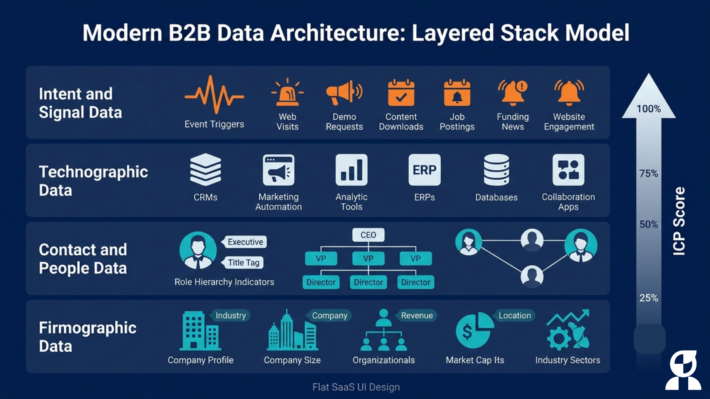
Sales intelligence is the practice of collecting and acting on external data about your prospects, their companies, and their buying context. It combines firmographic data (i.e. the company’s size, industry, and structure) with contact data identifying who holds the relevant role, and intent or signal data covering events such as funding rounds, leadership changes, or hiring spikes that indicate a buying window has opened or is about to. The purpose is to tell a seller who to contact, when, and with what message, so limited selling time goes to accounts that fit and are ready to move.
How does sales intelligence improve quota attainment?
It improves attainment through three distinct mechanisms.
First, it focuses the human sellers on accounts that match the ICP (Ideal Customer Profile) and show active buying signals, rather than on prospects that will not close regardless of effort.
Second, it raises win rates by giving human sellers the account context to personalize each conversation and prepare better for their meetings. ZoomInfo’s 2025 data ties this to a 46% win rate versus 32% without it.
Third, it makes the sales forecast more reliable by qualifying leads against a consistent standard before they enter the pipeline, so a sales leader can identify and act on the gap to target while time remains.
Why do so many B2B sales teams miss their targets?
The leading cause is misdirected effort, not insufficient effort. Analysis of more than 150 sales teams found that chasing the wrong deals is the single biggest reason teams fall short of quota. Contributing structural factors include reps spending under 30% of their day in actual selling activities, sales cycles lengthening across most categories, buying committees expanding to six or more stakeholders, and quota levels that in many organizations have risen faster than market conditions support.
Can sales intelligence help small SMB sales teams and founders, not just large sales organizations?
Yes, and the benefit is often proportionally larger for small teams. Founders and small sales teams typically start with strong instinctive knowledge of their buyers, but that knowledge does not scale once open opportunities exceed what one person can hold in active memory. Sales intelligence, especially when it automates the research and qualification layer, preserves account-level understanding as the team and pipeline grow, without requiring the dedicated operations functions (i.e. GTM Engineering, or dedicated Sales Operations roles) a large enterprise relies on to do the same job.
Is sales intelligence the same as a CRM?
No. A CRM stores and organizes information you already have about deals and contacts you are already managing. Sales intelligence supplies the external information that sits upstream of the CRM: which accounts are worth pursuing in the first place, which contacts hold the relevant decision authority, and which accounts are currently showing buying signals. The two work together: sales intelligence feeds qualified, enriched, and prioritized accounts into the CRM, where the team will take over and manage them through the pipeline to close.
SalesOMMO is the GTM Intelligence platform for entrepreneurs and B2B sales teams. No more spray-and-pray. No more AI-slop. Upgrade human judgment with data and insights. Amplify humans, not inboxes.
Get up to 150 new ICP-scored MQLs per month, with optional Agentic-AI qualification to narrow those into the SQLs that genuinely deserve your time. Full feature detail (ICP Score, Executive Brief, Agentic-AI qualification) at salesommo.com/features.
Free to start. From €99/month at salesommo.com.