Sales Intelligence: What It Is, Why It Matters in B2B, and How GTM Intelligence Takes It Further
TL;DR: Sales intelligence is the practice of collecting and acting on external data about your prospects, their companies, and their buying context, so you qualify and reach only the right people at the right moment, with something genuinely relevant to say. People in sales using it consistently win more deals, at higher average deal sizes, than teams selling without it. The reason is structural, not motivational: they know more before the first conversation. This article covers what sales intelligence actually is, why it matters more now than it did five years ago, where it breaks down for founders and small B2B teams, and how SalesOMMO’s GTM Intelligence automates the parts that otherwise consume the day.
The Real Cost of Selling Without Intelligence
A person in sales spends roughly two hours of an eight-hour day actually selling. HubSpot’s sales productivity data puts active selling at approximately two hours daily, and Research Nester estimates that across the wider B2B sales profession, people spend only around 29% of their working time in actual client engagement.
The remaining 70% goes to research, data entry, internal coordination, and the slow, expensive process of figuring out which leads are worth a conversation at all.
That gap is not a motivation problem. It is a system problem. And the system that exists to close it is called sales intelligence.
If you are selling complex solutions to other businesses (i.e. running 30 open opportunities in parallel, working a prospect list that decays faster than you can qualify it, trying to decide which five accounts deserve your attention this week) then the practice described in this article is more specific and more learnable than the category name suggests. It is also the foundation that the rest of the SalesOMMO platform is built on top of.
What Sales Intelligence Actually Means
Sales intelligence is the collection, enrichment, and interpretation of data about your prospects and their business environment, processed into something a seller can act on directly.
It answers three questions that a CRM record alone never answers: who should you be talking to, why right now, and what should you actually say when you reach them?
It is worth separating it clearly from the things it gets confused with. A CRM stores what you already know about people you have already engaged. Marketing automation sends messages at scale to lists you have already built. Sales intelligence sits upstream of both — it supplies the outside-world information that tells you which records are worth creating and which messages are worth sending in the first place.
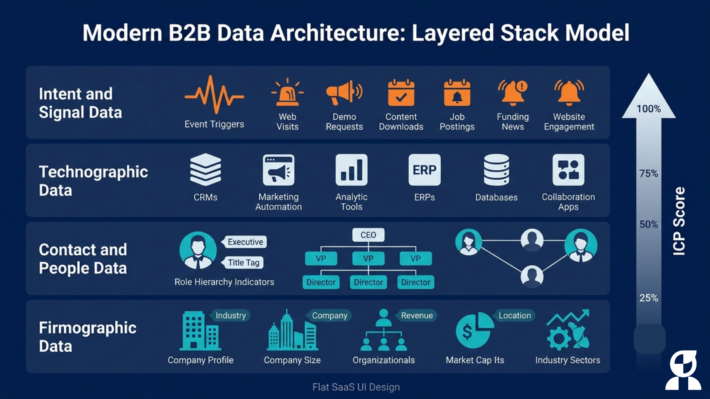
The three layers stack in a clear hierarchy:
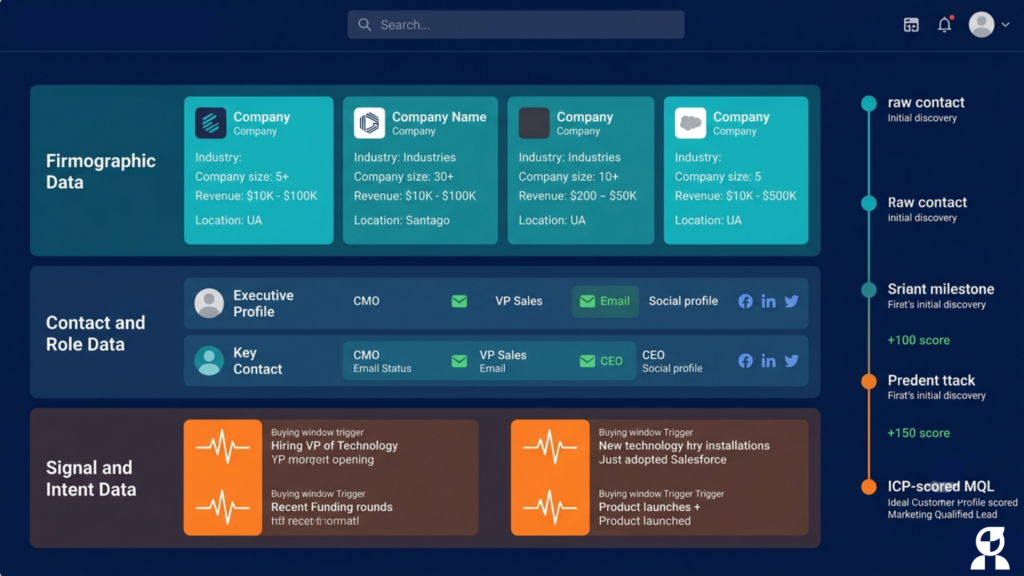
1. Firmographic data covers the company itself: size, revenue, number of branches, industry, geography, ownership, and other facts that tell you whether this organization fits your Ideal Customer Profile at all.
2. Contact and role data covers the people inside it: who holds the relevant position, their seniority and likely authority, how to reach them, and enough professional context to understand their perspective before you engage.
3. Signal and intent data covers the timing: funding rounds, leadership changes, hiring spikes, technology adoptions, and other events that indicate a buying window may have opened, or be about to. This third layer can tell you when to move, not just who to target.
A sales intelligence platform that gives you all three layers, kept current, is what separates a real intelligence practice from a static contact list that was accurate when you bought it and meaningfully wrong by the time you use it.
B2B contact records decay at roughly 30% per year as people change roles, companies restructure, and contact details go stale. A list accurate in January is not the same list in August. This is why sales intelligence is a continuous practice, not a one-time database purchase.
Why Sales Intelligence Matters More Now Than It Did Before
The case for sales intelligence rests on a specific and well-documented shift in how B2B buying actually happens. The numbers behind that shift are worth knowing precisely, because they reframe what the seller’s job actually is in 2026.
Buyers form their shortlist before they talk to anyone.
6sense’s Buyer Experience Report, built on responses from nearly 4,000 B2B buyers, found that buyers rank their preferred vendors before making first contact with any of them, and that the vendor who leads that pre-contact shortlist goes on to win the deal roughly four times out of five.
By the time a prospect raises their hand and requests a demo, the shortlist is largely formed. The decision is not being made during your sales process. It is being made during their research process, which you are not in the room for.
This rewrites what the seller’s job is. If the shortlist forms during the research phase, waiting for an inbound lead and responding to it puts you in a race you are already behind on. The sellers who win proactively identify accounts entering a buying window, understand their context, and reach them with something relevant while the shortlist is still being assembled. That is precisely what sales intelligence enables: surfacing the signal before the buyer surfaces themselves.
Knowing the buyer before the call changes the outcome measurably.
ZoomInfo’s 2025 Customer Impact Report found that teams using sales intelligence closed 46% of their deals, compared to 32% for teams selling without it. This 14-point win rate gap compounds significantly across a year of pipeline. The same data shows a 40% lift in average deal size among intelligence-driven teams, with enterprise account values roughly doubling in the cases where the practice was most deeply embedded.
The mechanism is not mysterious. When you understand and adapt to a company’s specific situation before you contact them, your outreach stops sounding like every other vendor’s sequence.
You reference the actual change in their business that makes your solution relevant right now.
You speak to the person whose problem you address, in language that reflects their industry and context. The conversation starts further along not because you pitched harder, but because you did the homework that most sellers skip.
Proactive selling closes at a structurally higher rate.
Research presented at the 2025 Emblaze Revenue Summit found that seller-initiated opportunities close at 33% to 41%, while buyer-initiated, reactive opportunities close at 18% to 25%.
The majority of pipeline in most sales organizations still comes from the reactive side, despite the fact that proactive deals win at nearly double the rate.
Sales intelligence is what makes proactive selling viable at scale for a small team.
Going out to find the right accounts is only worth doing if you can identify them quickly, and prioritize accurately. That is a data problem before it is a sales effort or process problem. Solve the data layer, and the proactive motion that elite sellers run on instinct becomes something a three-person team can run as a system.
Where the Practice Breaks Down, And Why It Breaks Down Predictably
The benefits are well documented, which raises an honest question: if sales intelligence works this clearly, why do so many teams still sell without it? The failures are predictable, and most of them come down to data quality, volume bias, and the time cost for small teams that do it manually.
The first failure is data quality. Intelligence built on stale, fragmented, or unverified records does not just fail to help, but it actively misleads. A human seller who has the wrong contact will waste time in conversation with the wrong persons at the wrong companies. Given the 30% annual decay rate in B2B data, the difference between a platform that refreshes continuously and a database someone exported last quarter is the difference between a competitive advantage and a well-organized liability.
The second failure is volume bias. Many teams with access to sales intelligence data respond by scaling volume: more contacts, more automated sequences, more messages sent to more people. This is the spray-and-pray motion repackaged with a data layer on top, and experienced buyers have learned to recognize and ignore it. Sales intelligence is not for industrializing the outreach. It is to talk to fewer people with more relevance, and this is the opposite of what most outreach automations do.
The third failure is the time cost for small teams. The entire practice assumes someone has the hours to do the research, the qualification, and the preparation for every prospect worth contacting. A founder performing their own sales while managing product, team, and investors does not have those hours. A three-person sales team covering 30 open opportunities across multiple verticals does not have them either. Without automation at the research and qualification layer, the practice collapses back into the same problem: people spend only around 29% of their working time in actual client engagement.
This is exactly the gap SalesOMMO’s GTM Intelligence was designed to close. Let’s see how.
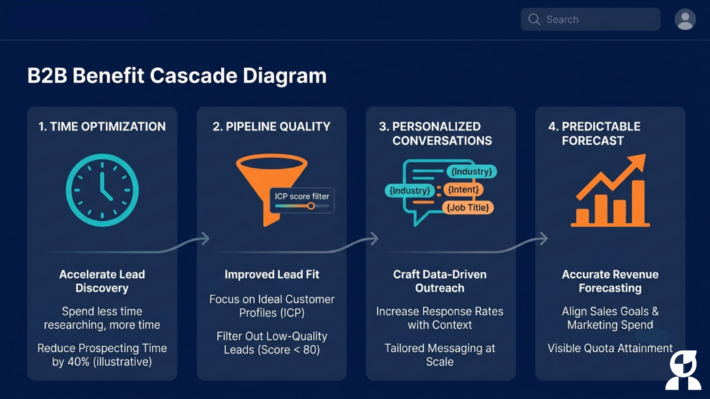
Automating outreach scales the noise that buyers already filter out. Automating research and qualification scales the one thing buyers consistently reward: a human seller who arrives at the first conversation with a potential human buyer having clearly done their homework. SalesOMMO is built around the idea that preparation is where the win rate improvement actually comes from.
The platform delivers new ICP-scored leads daily, applies Agentic-AI qualification to advance the highest-fit leads from MQL to SQL automatically, and generates an Executive Brief for each qualified prospect before you make contact, with company context, key executive background, industry challenges, suggested questions, and anticipated objections.
The routine work that consumes the day is handled by the system. The decision about who to pursue and how to win them stays with the human, which is where it should be.

How Sales Intelligence Connects to GTM Intelligence
Sales intelligence is a critical component layer, but it is one part of a broader architecture that high-performing B2B teams are building in 2026. GTM Intelligence (the category SalesOMMO operates in) goes further.
Traditional sales intelligence focuses on the data about prospects, GTM Intelligence connects that data to qualification logic, preparation workflows, personalized outreach drafting, and CRM integration, in a single system designed for the pace and resource constraints of entrepreneurs and small sales teams.
The data layers described above (firmographics, contact, and signal data) feed directly into SalesOMMO’s ICP Score, which qualifies every incoming lead automatically against the Ideal Customer Profile you define. The qualifying leads then receive an Executive Brief that processes all available intelligence into something directly actionable: the context, the questions, and the outreach you need before the first conversation.
The less-is-more sales strategy is applied at the infrastructure level. You work fewer accounts. Each one gets more preparation. Win rates improve not because activity increased, but because the right intelligence reached the right human seller at the right moment.
For a deeper look at how the full GTM Intelligence system works, including the data table of signal categories and AI-processed outputs have a look at the GTM Intelligence pillar on salesommo.com that covers the architecture in detail.
For the qualification layer that turns sales intelligence data into prioritized, SQL-ready pipeline, the Agentic-AI qualification guide on salesommo.com walks through what the agents actually do and what they deliberately do not do.
Making It Work: The Sequence That Matters
If you are building a sales intelligence practice from scratch, the sequence matters more than the tool selection. This is the order that works.
Start with a precise Ideal Customer Profile, not just a job title and an industry code, but a documented description of the company type and buyer persona you actually win with, that includes the specific business pains your solution addresses. Without this, intelligence data has no filter to run through and produces volume rather than signal.
Identify the accounts that fit the profile and, more importantly, the ones showing a signal that a buying window has opened. A funding announcement, a leadership change, a hiring spike in a relevant department, or a technology adoption in your category are all indicators worth acting on before the account appears in anyone’s inbound queue.
Qualify hard and early, so your time and attention go to the accounts that are genuinely worth pursuing rather than the many that merely exist on a list. The qualification work is where most of the time savings in a well-run intelligence practice accumulates.
For a detailed framework on how to qualify consistently, the lead qualification series on the SalesOMMO blog covers the process, the criteria, the frameworks, and the questions in four dedicated articles: starting with what lead qualification is and the criteria that predict a closed-won deal.
Prepare properly before first contact, so the opening conversation starts with evidence that you understand the buyer’s situation. This is the moment where the sales intelligence investment either pays off visibly or gets wasted on another generic introduction.
Keep the data current. The entire practice degrades if the intelligence layer is not refreshed continuously. A static database and a live intelligence platform are not the same tool, and treating them as equivalent is one of the fastest ways to end up back at 29% selling time.
None of these steps are new. Experienced B2B sales performers have always done them. What has changed is that you no longer need to do them by hand, and the teams that automate the research, scoring, and preparation layers are compounding an advantage over the teams that still treat prospect research as something to squeeze in between calls.
The Market Signals the Direction
The global sales intelligence market is projected to reach $6.68 billion by 2030, with adoption growing fastest among smaller organizations that previously could not access this category of data at all. The infrastructure that once required a dedicated GTM engineering team and a six-figure data budget is now within reach of a founder selling a €2,000 to €50,000 solution who needs to know which five accounts to call this week and what to say when they get on the call.
That is the real shift. The seller who knows more before the first conversation wins more of the deals. That was always true. What is new is that knowing more is no longer reserved for teams with the budget and headcount to build it manually.
Fewer calls, better prepared, higher win rates.
SalesOMMO is the GTM Intelligence platform for entrepreneurs and B2B sales teams. No more spray-and-pray. No more AI-slop. Upgrade human judgment with data and insights. Amplify humans, not inboxes.
Get up to 150 new ICP-scored MQLs per month, with optional Agentic-AI qualification to narrow those into the SQLs that genuinely deserve your time. Full feature detail (ICP Score, Executive Brief, Agentic-AI qualification) at salesommo.com/features.
Free to start. From €99/month at salesommo.com.