Benefits of Sales Intelligence for B2B Teams: Time, Pipeline, Conversations, and Forecast
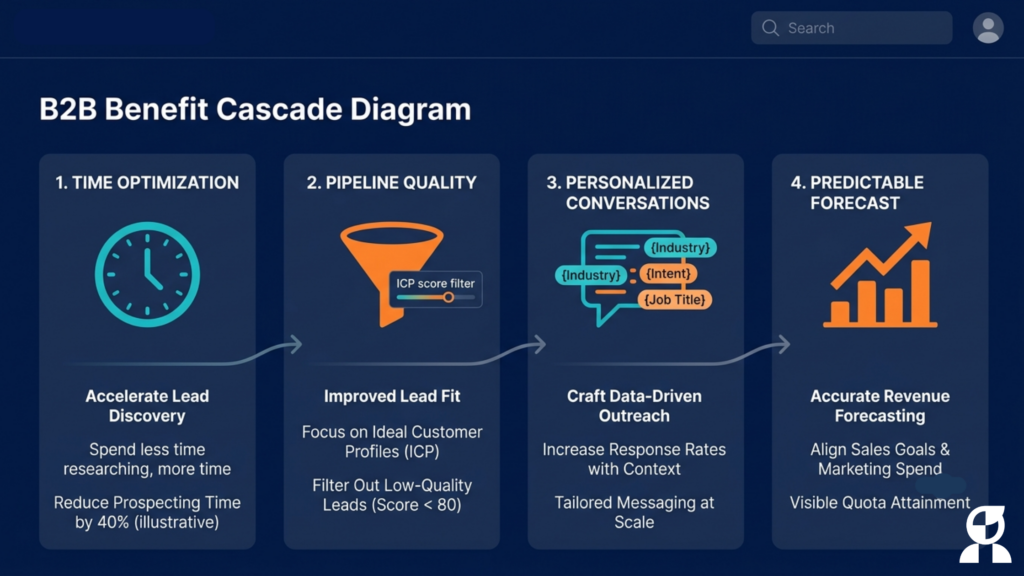
TL;DR: Sales intelligence changes what a B2B team can produce with the same headcount by automating the research that currently consumes most of the working day. The benefits are not parallel, they compound. Reclaimed time feeds a sharper pipeline. A sharper pipeline produces more relevant conversations. More relevant conversations make the sales forecast something you can actually manage against. This article covers where each benefit comes from, why it appears, and what a small team needs to do to actually capture it rather than buy a tool and change nothing.
The Mechanism First, Because It Explains Everything Else
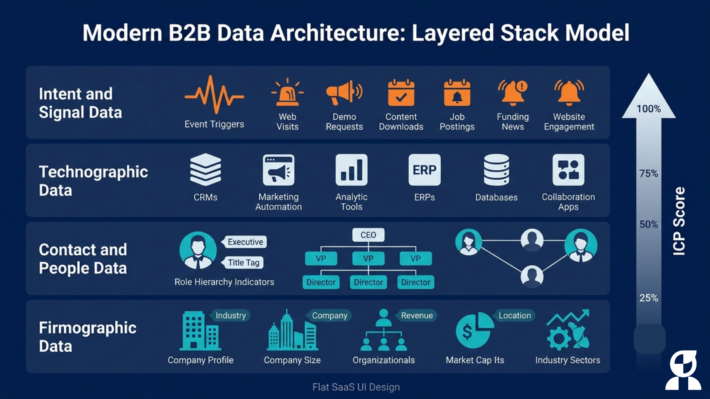
A B2B seller’s results depend on three decisions made daily: who to contact, when to contact them, and what to say. Made well, on accurate information, those decisions produce qualified pipeline and closed revenue. Made on guesswork (and this is what a seller does when the data layer is missing or stale) they produce activity that goes nowhere and a predictable quarter-end miss.
Sales intelligence improves all three decisions by supplying the outside-world information they require. It is information a CRM does not hold, because a CRM stores only what you already know about contacts you have already engaged. It is information most B2B sellers do not have time to gather by hand, because doing it manually for every account in a 30-deal pipeline consumes the part of the day that should go to conversations.
This is why the benefit is structural rather than cosmetic. Intelligence removes the blind spots the sales motion was already running on. McKinsey’s estimate that AI applied across sales and marketing could add $0.8 to $1.2 trillion in productivity globally reflects exactly this: most of the value comes from redirecting human effort away from work a system can handle and toward work only a human can do.
Sales intelligence is the layer inside the sales process that performs that redirection. The four benefits below all flow from it.
Benefit One: Reclaimed Selling Time
The first and most immediate benefit is time, because time is the resource the entire job is most constrained by.
A B2B sales rep spends roughly 28 to 30% of the working day actually selling. The remaining 70% disappears into prospecting, research, data entry, tool-switching, internal coordination, and the slow, expensive process of deciding which accounts are even worth pursuing. Sales intelligence directly addresses the largest single drain in that 70%: account research.
Research stops eating the day. Pulling a company’s background, finding the right contact, checking for recent leadership changes or relevant news, and assembling enough context to write a message that does not sound generic — done manually for every lead in the pipeline, this takes 20 to 40 minutes per account. Multiply that across a week and it is not a minor inefficiency. It is the primary reason a seller spends less than a third of their day in actual selling activity. Sales intelligence performs this gathering automatically. The seller starts each day with the context already in front of them, not with the task of assembling it before they can do anything else.
Tool-switching stops fragmenting attention. A seller working without an intelligence layer jumps between a CRM, a search engine, a professional network, a company news feed, a notes file, and a spreadsheet to construct a single account picture. Each switch costs attention and adds inconsistency — the picture built for account A looks different from the one built for account B, because different tools were used on different days. Consolidating that gathering into one enriched, structured record removes the switching cost and produces a consistent view the seller can trust across the full pipeline.
The time reclaimed compounds, not just saves. An hour returned to actual selling every day is not a one-time efficiency improvement. Across a 90-day quarter it becomes additional qualified conversations, additional pipeline, and additional closed deals from exactly the same headcount. This is the practical shape of the McKinsey productivity figure at the team level: the same people produce more because their effort lands on the work that actually matters.
Benefit Two: A Higher-Quality Pipeline
Time reclaimed is wasted if it pours into the wrong accounts. The second benefit is a pipeline that is worth the hours being invested in it.
Fit scoring filters out accounts that were never going to convert. Most B2B pipelines carry a long tail of accounts that looked plausible when they entered and never progressed. The seller discovers this only after investing real research, call preparation, and follow-up time. Scoring every account against a precisely defined Ideal Customer Profile — before any meaningful time is spent — filters that tail out early. The pipeline that remains is smaller in volume, but the expected return on each account in it is materially higher. This is the less-is-more sales strategy applied at the pipeline level: fewer accounts, more conviction, higher win rate on the ones that remain.
Intent signals tell you which fit accounts are ready to move right now. Fit tells you which accounts are worth pursuing. Signals tell you which ones have an open buying window today. A funding round, a senior leadership hire, a relevant technology adoption, a team expansion in a division your solution serves — these are the events that indicate a prospect is actively re-evaluating their current approach. Surfacing them means you reach the account while the need is live, not three months after a competitor already had the conversation. Timing is the variable that separates a proactive, seller-initiated opportunity — which research shows closes at 33 to 41% — from a reactive, buyer-initiated one that closes at 18 to 25%.
Working fewer, better-qualified accounts beats working more, poorly-qualified ones. Under quota pressure the instinct is to add volume — more leads, more outreach, more pipeline entries. Sales intelligence runs the opposite direction. A focused pipeline of fit, in-market accounts converts at a rate a large pipeline of loosely qualified prospects never matches, and does so while consuming significantly less of the team’s time and attention. The math favors precision. It always has. Intelligence is simply what makes precision achievable at scale for a team that does not have a dedicated research analyst.
Benefit Three: More Relevant Conversations
A better pipeline sets up the third benefit, which determines what actually happens in the conversations that result from it.
Personalization that references the buyer’s real situation. Buyers can tell within the first sentence whether a seller did the work. A message that references the specific change in a company’s situation that makes your solution relevant right now earns a response. A message that opens with a generic pitch the buyer has received from four other vendors that quarter does not. Sales intelligence gives the seller the account context to open with something specific: the recent hire, the announced initiative, the industry challenge that is putting pressure on this buyer’s team right now. Specificity is what earns the second meeting, and the third, and eventually the close.
Reaching the right person in an increasingly complex buying group. B2B purchasing decisions now routinely involve six or more stakeholders, each with a different concern, a different frame of reference, and a different threshold for engagement. Reaching the wrong one on the first contact wastes the only window where first impressions can be made. Sales intelligence identifies who holds the relevant role at a specific company — not just the generic title, but the actual person with seniority and proximity to the decision — so the first contact lands with someone who can move the deal rather than someone who will forward it to the right person and lose momentum in the handoff.
Earning trust earlier, which compresses everything that follows. A conversation that demonstrates genuine understanding of the buyer’s business builds credibility faster than one that demonstrates persistence or pitch volume. When a seller arrives at the first conversation already knowing the company’s context, the buyer’s likely pressures, and a relevant reason for the meeting, the relationship starts from a position of credibility rather than a cold opening that has to earn the right to continue. Trust built early shortens every subsequent stage of the sales cycle, because the buyer is spending less time deciding whether to trust you and more time evaluating whether to buy from you.
Benefit Four: A Forecast You Can Actually Manage Against
The fourth benefit is the one sales leaders and founders feel most directly, because it determines whether a quarter is managed proactively or merely survived.
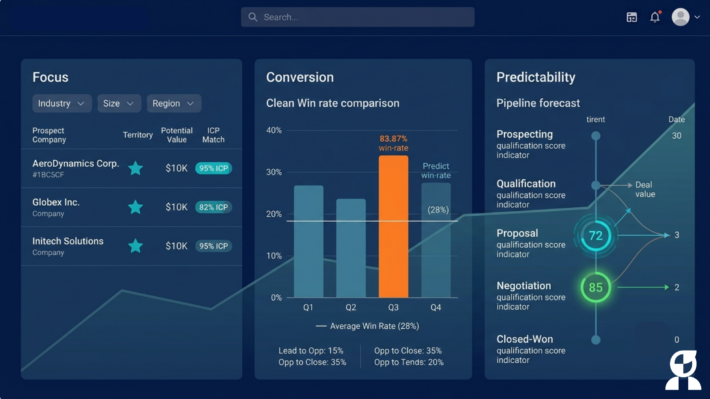
Qualification makes the pipeline mean something. A forecast built on unqualified opportunities is a wish list wearing a number. When every lead is evaluated against a consistent ICP score and qualification standard before it enters the pipeline, the forecast reflects accounts with genuine buying signals rather than accounts that accepted a meeting and went quiet. The number on the board starts to correspond to reality, which is the precondition for managing to it.
A real forecast is an early-warning system, not a post-mortem. The value of a reliable forecast is not that it tells you what happened. It is that it shows you the gap to target while there is still time to act on it. A sales leader who can see in week four that three of the eight deals marked as likely-to-close have no verified decision-maker confirmed is a leader who can redirect the team’s effort before the quarter is gone. Discovering the same thing in week twelve is a different situation entirely. Intelligence-backed qualification is what makes the difference between the two.
Cleaner data improves the structural decisions too. Reliable, current account information improves not just the deals in the immediate pipeline but the decisions that determine next quarter’s starting position: how territories are structured, which market segments are getting enough coverage, where the next hire should focus, and which ICP definitions need updating based on what has actually been closing. Decisions made on accurate, live data hold up. Decisions made on stale records quietly misallocate the team’s time and then produce a miss that is impossible to explain cleanly.

How to Actually Capture These Benefits — Not Just Buy the Tool
The benefits above are real and measurable. They are also not automatic. A team that purchases a GTM Intelligence platform and changes nothing about how it works will see limited return, because intelligence data only produces a result when the process around it is built to use it.
The practices that determine whether a team captures the return are straightforward, but they require discipline.
Define a precise Ideal Customer Profile before anything else. Every benefit downstream — the fit scoring, the intent signals, the pipeline quality, the forecast reliability — depends on a specific definition of who you are actually looking for. A vague ICP produces vague scoring and a pipeline no cleaner than before. The investment in getting the profile right at the start pays back across every quarter that follows.
Qualify accounts before investing significant time in them. The ICP score and intent signals are inputs to a decision, not a substitute for one. A sales rep who scores leads but then works all of them anyway has not changed the pipeline. One who uses the score to decide which accounts get this week’s calling hours has.
Automate the research and qualification layer, not the outreach layer. This is the distinction that separates teams that get a genuine return from teams that scale their noise. Automating outreach sends more generic messages to more people and trains buyers to ignore you faster. Automating research and preparation scales the thing buyers actually reward: a seller who arrives knowing their business.
The human-in-the-loop architecture — AI handles the research, the scoring, and the first draft; the human handles the judgment, the relationship, and the decision — is the design that works.
Keep the data current. B2B contact and company data decays at roughly 30% per year. A list that was accurate in January is materially wrong by autumn. Intelligence built on stale data misleads rather than helps, and the damage compounds because decisions made on bad data produce bad outcomes that are hard to trace back to the source.
What This Looks Like in Practice With SalesOMMO
SalesOMMO’s GTM Intelligence platform is built to deliver exactly this sequence for founders and small B2B sales teams selling solutions in the €2,000 to €50,000 range.
The platform scores every incoming lead automatically against the Ideal Customer Profile you define, delivering ICP-scored MQLs daily so the pipeline is built on fit from the start. Agentic-AI qualification advances the highest-fit accounts from MQL to SQL automatically, based on publicly available signals rather than guesswork. An Executive Brief is generated for each qualified prospect before first contact — company context, key executive background, relevant industry challenges, suggested questions, and anticipated objections — so the seller arrives at every conversation with the preparation a larger team would assign to a research analyst.
The routine work that currently consumes the 70% of the working day that is not selling gets handled by the system. The decisions about who to pursue, which conversations to prioritize, and how to win each deal stay with the human selling. That is the architecture that produces the compounding return described above — and it is the only one that does.
Frequently Asked Questions
What are the main benefits of sales intelligence for B2B teams?
The four that compound most directly are reclaimed selling time, higher-quality pipeline, more relevant conversations, and a more reliable sales forecast. They are connected sequentially: automating research returns hours to the team, those hours go into a pipeline filtered for fit and intent, the resulting conversations are more relevant because the seller understands the account before the first call, and consistent qualification makes the forecast reflect actual buying probability rather than wishful pipeline padding.
How does sales intelligence save sales reps time?
It automates account research and data gathering that otherwise consume a significant share of the working day. Instead of pulling company background, finding the right contact, and checking for recent changes manually across multiple tools, the seller starts with an enriched, current record already prepared. Research that previously took 20 to 40 minutes per account happens in seconds. Across a week, that time returns to actual selling activity and compounds into additional qualified conversations and closed deals.
Does sales intelligence improve win rates or just efficiency?
Both, and the connection between them matters. Efficiency improvements come from reclaimed research time and a pipeline filtered for genuine fit. Win rate improvement comes from the seller entering each conversation with account context that allows genuine personalization and ensures the first contact reaches the right person in the buying group with a specific, relevant reason to engage. The two effects compound: better-qualified accounts receive better-prepared sellers, which is where the measurable win rate lift actually originates.
How quickly do the benefits of sales intelligence appear?
Time savings from automated research appear almost immediately, typically within the first week of use. Pipeline quality improves as ICP scoring and intent signals begin filtering which accounts receive the team’s attention — this is visible within the first month. Win rate and forecast reliability build over a full sales cycle, because they depend on the improved pipeline and conversations flowing through to closed revenue. The compounding effect becomes most visible over a full quarter of disciplined use.
What does a team need to do to actually get value from sales intelligence?
Define a precise Ideal Customer Profile. Qualify accounts before investing significant time in them. Automate the research and qualification layer rather than the outreach layer. Keep the underlying data current. And keep human judgment on the decision of who to pursue and how to win them. A team that purchases sales intelligence but skips these practices typically sees limited return, because the data only produces a result when the process around it is built to use it consistently.
SalesOMMO is the GTM Intelligence platform for entrepreneurs and B2B sales teams. No more spray-and-pray. No more AI-slop. Upgrade human judgment with data and insights. Amplify humans, not inboxes.
Get up to 150 new ICP-scored MQLs per month, with optional Agentic-AI qualification to narrow those into the SQLs that genuinely deserve your time. Full feature detail (ICP Score, Executive Brief, Agentic-AI qualification) at salesommo.com/features.
Free to start. From €99/month at salesommo.com.